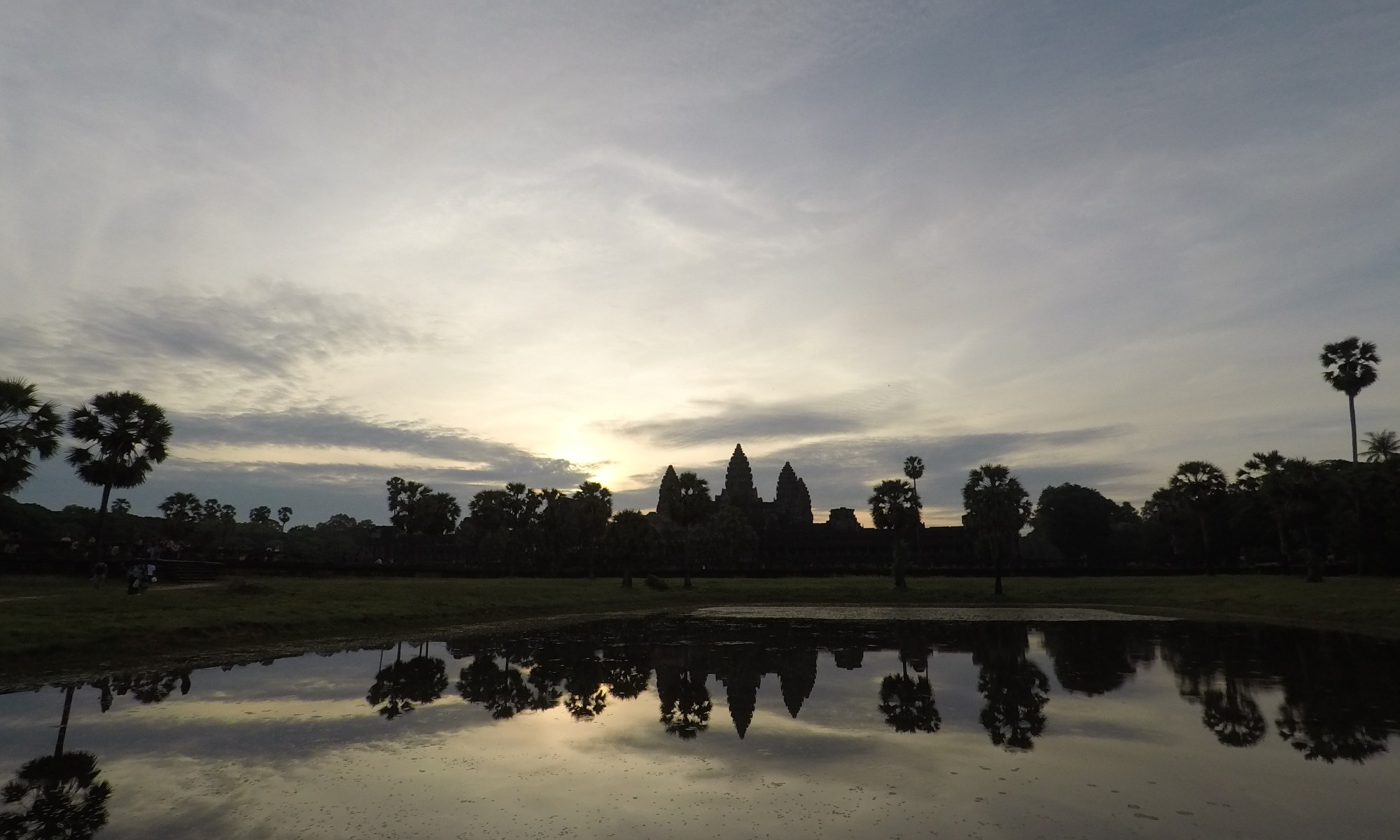
Cambodia was meant to be the first overseas trip in my period of funemployment between finishing up at work and (re)starting my studies. So, it’s a slight pity that I’ve written this from my work computer after being back at work for (already) four weeks.
Even this, though, can’t take away from how enjoyable, educational and enlightening the trip was.
Phnom Penh
Our first stop was Phnom Penh and we spent our few days here visiting some key tourist attractions (the Royal Palace, Tuol Sleng Genocide Museum, Killing Fields, Night Market, Aeon Mall). I didn’t find Phnom Penh to be particularly interesting as a city or destination–the only thing that really stood out for me was the history of the city. I found visiting the Genocide Museum and Killing Fields to be particularly chilling and poignant. There is this air of eeriness, which hangs around and instills (almost enforces) silence and respect (for the victims), and it is scary and difficult to believe that the atrocities happened less than fifty years ago.


We came back to Phnom Penh for an afternoon after our more rural adventures and shamefully, because it was so metropolitan and familiar-feeling, we reverted right back to comfortable habits from home, such as watching The Mummy at Major Cineplex (Aeon Mall) (definitely did not rate that movie, comical is probably my best assessment of the plot and acting). The fashion contrast between Kratie and Mondulkiri and the westernised Aeon Mall was amusing–my loose Cambodian cotton pants, which were in-line with what the locals wore in Kratie and Mondulkiri, made me stand out like the tourist that I was in Aeon Mall.
We wrapped up our last night by having dinner at Restaurant Le Royal (Raffles Hotel) and sampling their royal Khmer cuisine tasting menu. The food was fantastic and notably more delicate and refined compared to the Cambodian food we’ve sampled elsewhere; guess that was to be expected given the cuisine was handed down by the decree of the Royal Palace.
Mondulkiri
I was in two minds about visiting Mondulkiri–I loved the idea of visiting the Cambodian jungle (part of the “Wild East”) and seeing a completely different side to the country, but was not so keen on taking the 7-8 hour minivan trip (and somewhat concerned about the safety). As it turned out, I was unnecessarily concerned about the minivan trip, as it was surprisingly pleasant (driver wasn’t *too* reckless, aircon was operational and we had our own seats), made all the better by the beautiful and changing landscapes as we moved from the flatter plains near Phnom Penh to the hills in Mondulkiri.
We spent two full days in Mondulkiri. On our first day, we did the one-day Elephant tour with the Mondulkiri Project; I thought it was really worthwhile that they combined the experience of closely interacting with elephants with educating us about the region, the Bunong people and, naturally, elephants. The project had four elephants (that we met, observed and fed) and they were such friendly (and hungry) giants. They actually reminded me of Lucky–they ate all the food that was put in front of them, and some of them even tried to steal the food that we were saving for others!


On our second full-day, we hired a private car, primarily for the purpose of going to the Bou Sra waterfall for ziplining, but which also took us to some of the other attractions in the region (Sen Monorom Waterfall, Coffee Plantation, Sea of Forests and Wat Phnom Doh Kromom for sunset). Bou Sra waterfall is the largest waterfall in Mondulkiri and considered to be one of the most beautiful waterfalls by the local people. It’s allegedly a three-tier waterfall, but the third tier is hidden within the jungle and so, only the upper two levels are accessible. The Mayura Zipline is built around the waterfall and leverages the beauty and scope of the Bou Sra waterfall for its highlight–a 300m-long line that zips across the top of the waterfall. It was amazingly fun; because of the length, you gathered some speed whilst flying across and the view from above the waterfall was spectacular (200m above the ground and strong waterfall flows!). It was so great that we decided to do the zipline course twice.
I wanted to check out the waterfall (from eye level) afterwards. Apparently the wooden walkway that led to the lower falls is now closed, but no fear for us! Through some language miscommunication, we managed to find someone who agreed to take us down via bush-bashing through the jungle. Our guide was carrying and using a scythe to create a path and after a long and hot 30 minutes, we finally made it. The waterfall was impressively large and strong and I loved just standing at the bottom absorbing (literally) its sight, sound and feel of the waterfall; working for the experience make it even more worthwhile.


Mondulkiri was definitely one of the highlights of the trip. Also, Mondulkiri Pizza made some of the best pizza I’ve had, ever.
Kratie
I had never been dolphin watching before so, when I found out that there were dolphins in Kratie, I immediately wanted to go. Mondulkiri to Kratie isn’t one of the main routes serviced by the minivan/ bus companies so we ended up taking a shared van, which squeezed 24 people onto 14 seats, and also effectively provided a parcel delivery service. Thank goodness the trip was only ~4 hours.
Kratie is a small and quiet town that runs alongside the Mekong River. Our only goal in Kratie was to see the Irrawaddy dolphins so shortly after arriving, we left for Kampi (where dolphin watching is a key attraction, and the area is set up for it). The dolphins were a bit chill/shy/lazy (or all of the three) as they didn’t jump out of the water, but rather just surfaced slightly to breathe. Dolphin watching was relaxing; it was nice to spend a day on a boat, in the river and under the afternoon sun, and looking for the grey semi-circle of the dolphin’s back against the grey-brown water.


Kratie isn’t open until too late. When we finished our dinner at 10:30pm (at a local backpackers restaurant with cheap beers), we weren’t able to get a tuk-tuk and motorcyclists offered rides at exorbitant prices (US$20 to travel just 1.5km!) so, it was a long-ish, dark walk back to our equally dark hotel.
Siem Reap
Being completely honest, Siem Reap and in particular, the Angkor Archaeological Park, was why I wanted to visit Cambodia in the first place. I had seen so many photos of the place and I wanted some of my own. I didn’t expect to be more amazed by the history and intricacy of the Temples than I was by the outwardly appearance of them.
We decided to visit the key sites within the Angkor Archaeological Park in a day. It ended up being a long day, but it was well paced and I think it suited our style better. We started with sunrise at Angkor Wat, which was nice but not as spectacular as I had imagined. There was a bit of cloud cover so the colours of the sunrise weren’t so apparent. The morning was spent touring the Angkor Wat and Angkor Thom complexes and learning about their construction and the ancient Khmer civilisation–their beliefs, rituals and people. Walking around, I was super impressed by the detail in all the engravings and structures and the engineering and calculations that went into building the sites.


It was 10:30am when we finished seeing those two complexes and went back to the hotel for a break (to escape the midday sun and the early afternoon downpour). We recommenced our tour around 3pm and headed straight towards the “Little Circuit”. This part of the Park includes Ta Prohm and numerous other temples, which have all been invaded by tree roots. It was incredible to see how the temples are still standing despite being structurally challenged by the trees. Our last stop was Pre Rup, where we climbed towards the top and waited for the sunset. There weren’t too many people here and the weather and clouds decided to be kind; the sunset was beautiful and it was a perfect end to our visit to the Angkor Archaeological Park.


On our way back, we stopped by Pub Street, with its fluorescent lights, tuk-tuk-driven food and drink stops, and whilst it was fascinating to see, I’m glad we didn’t spend long there… and that our hotel was a good distance away.
On our last full-day, we spent the morning exploring Tonle Sap and the floating village, where the houses are built on stilts so as to still be above the water level during the wet season. We visited during the dry season (for the lake), so it was still possible to walk through the village and see the full design and architecture of the houses. On our tour, we learnt about the lake and the ecology within the system; pretty amazing to see (in pictures) how expansive the lake becomes in wet season and how clear the water is then.
That afternoon, we had a sunset quadbiking trip with Quad Adventure Cambodia ATV Tours (definitely recommend, so much fun!). I had thought we would be going in a large group, but instead, it was very private; we had own guide just for the two of us and we rode separately to the other groups (definitely a huge positive). We traversed through the rice paddies surrounding the town, with Cambodian children waving excitedly at us as we drove by them (they are sooooo friendly), before eventually stopping at a place to wait for and watch the sunset. It was very peaceful and pretty; our guide even offered to get us a beer whilst we waited.


We finished up with a visit to see Phare, The Cambodian Circus. It was absolutely AMAZING. On the night we went, they were performing Sokha, which follows the story of a Cambodian girl (the founder of the performing arts school, actually) as she overcomes the despair and trauma from surviving the Khmer Rouge and uses art to help others, especially children, do the same. The performers performed with remarkable energy, passion and precision and the historical and real-life overlay made the performance all the more special.
Battambang
We took a day trip from Siem Reap to Battambang (~3 hours away), which is apparently known for its colonial buildings, but frankly, I didn’t really think it was that impressive of a colonial town; you could definitely see the influences but, to me, felt more out of place than a step back in history.
The day didn’t start off particularly interestingly. Our first stop was Phnom Banan, an 11th century temple constructed at the top of the hill, which may have been more impressive had we not spent a day at Angkor Wat and surrounds just beforehand. The view atop the few-hundred steps was also quite limited. Our subsequent stops (Ancient House, Wat Po Veal, Governor’s Residence, main town) weren’t that impressive and it was starting to feel like that the day trip was a waste of a day that could have been better spent exploring Siem Reap.
Things did improve in the afternoon though. The ride along the Bamboo Train–effectively a bamboo raft manually placed on two sets of axles and wheels and affixed with a boat engine–was fun. It was refreshing to feel the breeze (especially since it was a very hot day) and we travelled surprisingly fast given how basic the equipment and set-up was.


Phnom Sampeau was our last stop for the day and it is known for its bat cave, killing caves, monastery and view. In a way, it was similar to the killing fields in Phnom Penh, where there is this extraordinary contrast between beauty and life in the present and the atrocities in the past. Our first stop up the mountain was the Killing Caves; although I had read about them online, I felt very under-prepared for the eeriness of the cave and the sight of the two glass cabinet displays filled with skulls and bones. Apparently, this was where the Khmer Rouge would dispose of the bodies that they killed nearby; there was also a separate skylight/ cave for babies, where the Khmer Rouge would throw (alive) babies into. There is apparently a cave network below the main landing but I didn’t have the guts to go deep into them.
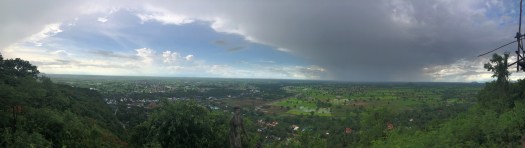
We progressed further up the mountain to the monastery where there was the most breathtaking view of lush rice paddies for almost as far as the eye could see. The monastery itself wasn’t a bad sight either, and neither were the monkeys that played and hung around. We didn’t stay late enough to see the bats fly out. It’s apparently meant to be an impressive sight, but so was our drive back with the sunset behind us and the endless rice paddies beside us.
+++
13 June 2017 – 24 June 2017
Trip Logistics (& Accommodation): Phnom Penh (Aquarius Urban Hotel and Resort) – Mondulkiri (Mayura Hill Resort) – Kratie (Ly Cheu Hotel) – Phnom Penh – Siem Reap (Phum Baitang) – Battambang – Siem Reap
 Lucky &New