This series is a bit (i.e. seriously) delayed… oops.
My introduction to Colombia (and South America, for that matter) was a week or so spent across three of Colombia’s cities–Cartagena, Medellin and Bogota–each of which had an entirely different vibe, making it fascinating and interesting to transition from one to the next.
Cartagena
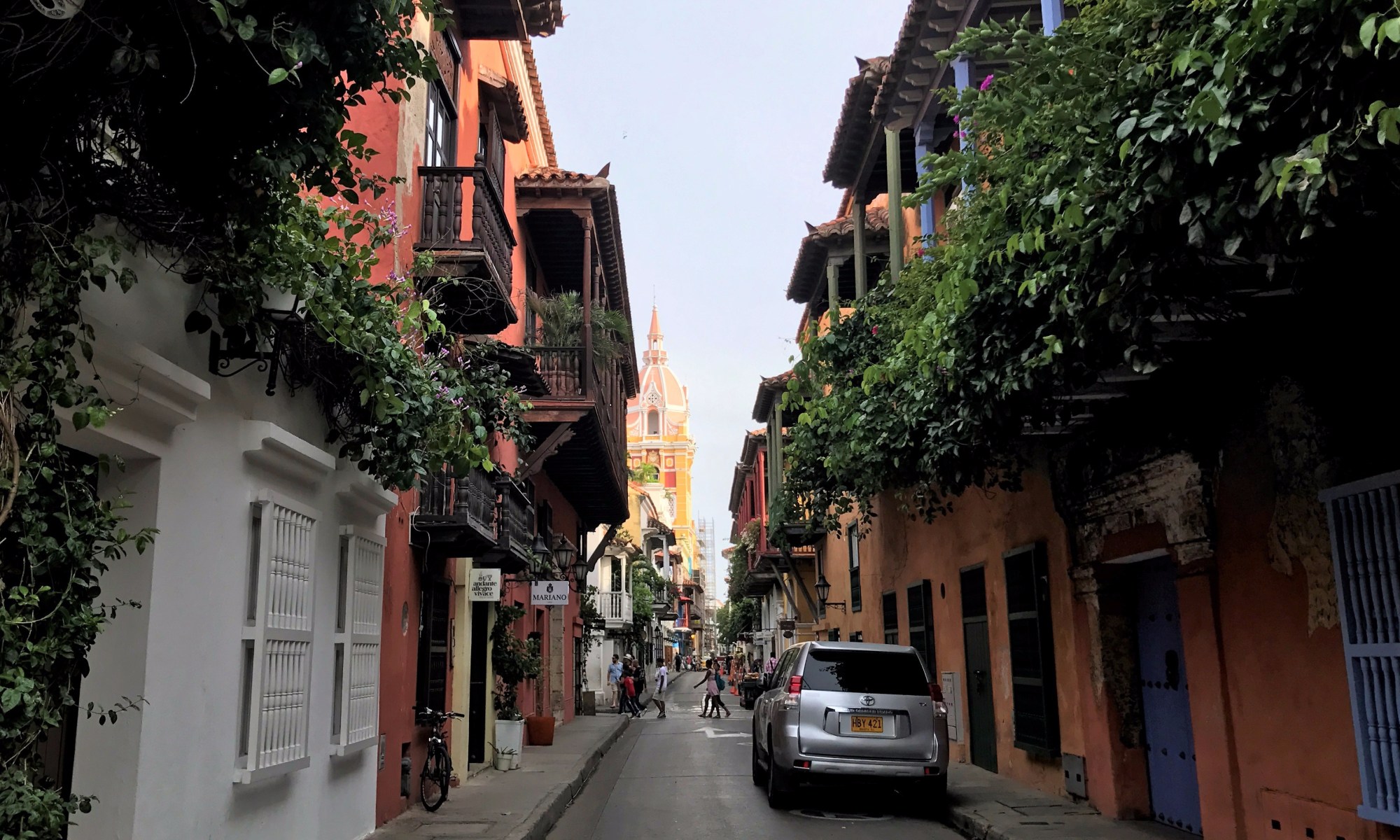
Our journey started in Cartagena. The historic town was exactly what I had imagined–cobblestoned streets lined by quaint buildings (homes, restaurants, shops) painted in a myriad of colours. We spent most of our time in this part of town and I enjoyed being able to leave the hotel and immediately feel like we were in a different time period. One of the sites we visited was Castillo San Felipe de Barajas, a 16th-17th-century fortress located on a hill, just outside the historical centre of Cartagena, with a commanding and strategic view over the bay and the city. It was built by the Spanish to keep both colonial enemies and pirates away and remains as one of the greatest forts built by the Spaniards in the Americas. We found the audio walking tour of the castle to be really informative and interesting, but be wary of the heat–it was sweltering the day we went and a lot of the walking tour was in direct sunlight.
We also spent a couple of nights in Bocagrande. The area reminded me of the Gold Coast in Australia, in that there were many new/ modern high-rise apartments right next to a long stretch of beach. It’s apparently one of the nicer areas to live in Cartagena but I found that hard to appreciate because of the connection I drew to the Gold Coast.
Due to various circumstances, we spent ~5 days in Cartagena and although we found the city to be charming (and having great food), we were ready to move on. We struggled with the heat and our lack of Spanish skills made it somewhat difficult to enjoy anything that was less touristy. Having said that, we thought the whole city was quite touristy, catered for both international travellers and Colombian tourists.


Medellin
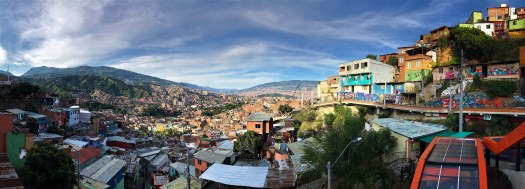
Medellin was our next stop and we were glad to have a change in scenery. It was probably also my favourite of the three cities that we visited in Colombia; there was a good mix of culture, history and character. On our drive from the airport to our hotel, we noted how large the city is–the view from Comuna 13, the Line J Metrocable (between San Javier and La Aurora) and paragliding in San Felix all reinforced this.
One of the first images that we saw of Medellin (prior to visiting the city), was that of colourful houses built into, what appeared to be, a mountain. And so, one of the first tasks we set for ourselves was to search for these houses. We hadn’t appreciated the history and background behind the art and the area and it was sad to learn of it, but also uplifting to learn about the transformation of the area and see the vibrancy and sense of community. We walked by a touching funeral, saw young children and teenagers playing street football and young adults dancing and painting.


We also took a day trip to Guatape where we climbed the rock, spent a few hours on a party boat (on the man-made Guatape resorvoir) and then walked around the town. The view of the reservoir and surrounding area (with some very impressive holiday houses) from both the top of the rock and on the water was amazing and beautiful. The town itself was very colourful, charming and welcoming–wish we could have spent more time there!


As a side note, I was impressed with how the city integrated cable cars into its public transportation system; it’s a very ingenious way to connect the districts in a city that builds up into the surrounding hills/ mountaints.
Bogota
Bogota is the capital and an incredibly large city. If I thought the city of Medellin was sprawling, it was nothing compared to Bogota. At Monserrate (a lookout point), the city stretched out as far as I could see and more.
We didn’t spend much time in Bogota. Two of the sites we checked out were: La Candelaria and Monserrate. La Candelaria is the historic (and political) district and maintains the colonial architecture, distinct from the modern buildings in the rest of Bogota. The whole area felt very set up for tourists, from the street vendors offering big bottom ants (did not try this) and the line of cafes all selling hot chocolate with cheese (did try this one). Monserrate is a mountain in Bogota with a cathedral and (awesome) lookout point of the city. Unfortunately, we visited on a Saturday evening (i.e., extremely crowded) and spent more time waiting in lines (~2hrs aggregate) than appreciating the view. It didn’t make the view less impressive but it did partially hurt the visitor experience.


I didn’t leave Bogota with the best experience–the size, coupled with the traffic, made it less tourist-friendly (in my view)–but I could definitely see it as a cooler place for people to live and who are in the know (there seemed to be many cool restaurants and bars and Andres Carne de Res is definitely something special). We also had an aggressive taxi driver on one occasion, which soured the experience.
+++
16th August 2017 – 26th August 2017
 Lucky &New