From Bogota, we began the more adventurous portion of our Colombian travels. There were two main agenda items for this portion of the trip: Cocora Valley and Laguna Verde.
Salento
Salento is a small, colourful and vibrant town located west of Bogota. We arrived on a Sunday and the town was buzzing with activity–there were heaps of people, food-carts along the street, side-street games and food trucks in the main plaza–notably different to the vibe the next day. At one end of the town, there is a series of steps that leads up to a mirador (lookout) from where you can see the whole town on one side and rolling mountains on the other. It was a stark contrast from the lookout in Bogota, but very much welcome (for me).


Our main agenda item was to visit the Valle del Cocora and so, on our second day, we set out early for the hike around Cocora Valley. The hike was much more difficult than we expected; the path was muddy from the rain from the night before and the intermittent (but vicious) rain during the walk didn’t help. After a short while, we reached a fork in the path–to the right was the path to Acaime (the hummingbird reserve) and to the left was the path to La Montaña.
We took the path to Acaime by accident, but it turned out to be a good break from the rain and the hike and the hummingbirds were very pretty. The only downside was needing to retrace our steps to get back onto the path to La Montaña. The climb up to La Montaña was steep and intense (and still muddy). There’s a lookout at the top that’s meant to promise a great view; unfortunately, the only thing we saw was fog and rain.
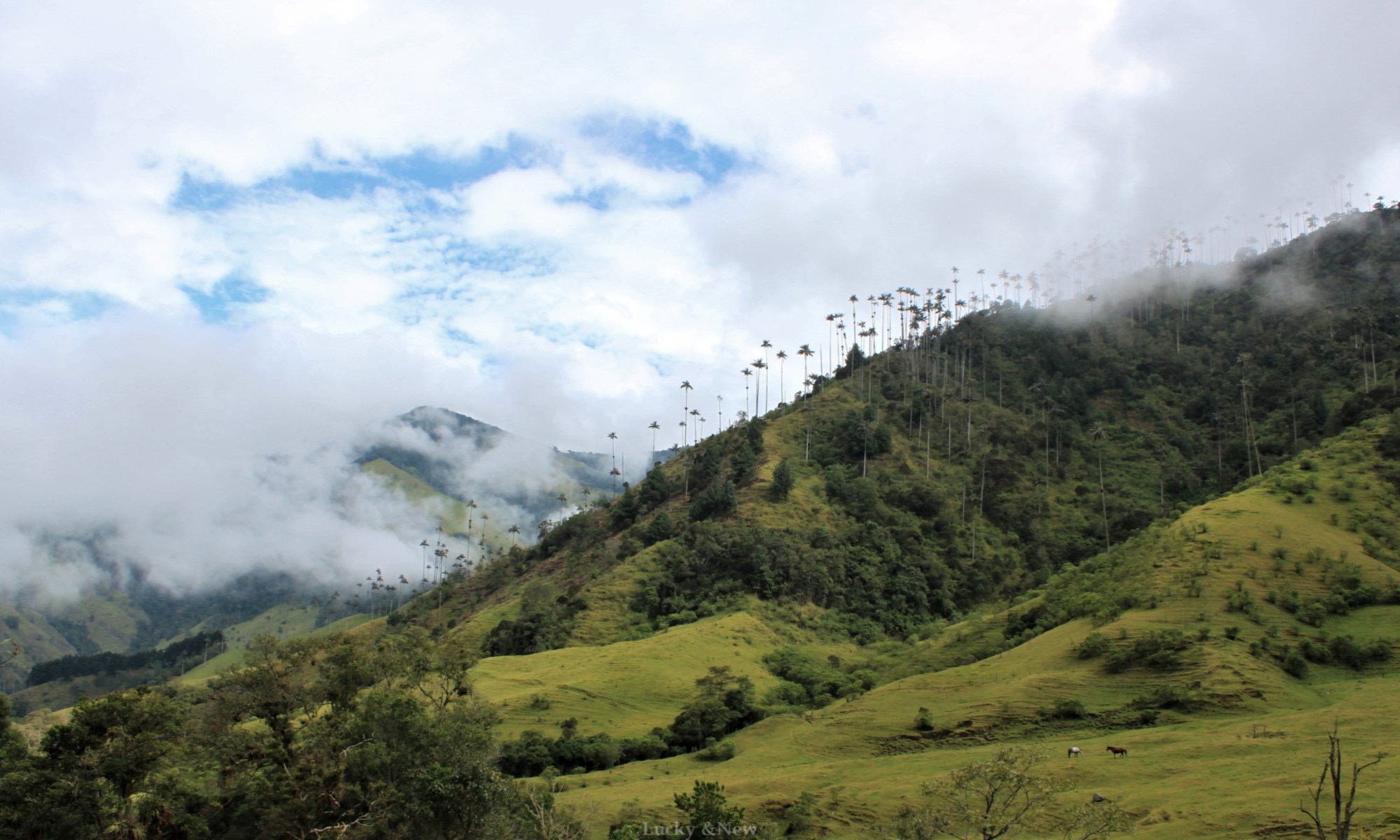
The walk thereafter to the wax palm trees was easy, mostly downhill and on a clearly defined path. There were a glimpses of the trees along this path, which provided a lot of motivation to keep going and the improving weather also kept spirits high. After a while, we turned a bend and the wax palms were visible in all their glory. I was in wonderment. The palm trees were breathtakingly beautiful and it was amazing to see them spotted aross the mountains.
The trail is a bit funny in that, at the beginning, you can see the palm trees in the distance but they slowly disappear from view and for the majority of the portion of the track, it was more about rivers and bridges–made us question if we were going the right way!
In total, we spent ~6 hours doing the hike and (apparently) climbed the equivalent of 129 floors; it was definitely worth it. It’s also possible to see the wax palms earlier by doing the loop in reverse (or just going to the palm trees and then doubling back), but working hard to see the wax palms made the view much sweeter.


Salento is located in what is known as the “coffee triangle”, a region that is renowned for the organic coffee that it produces. Apparently, the geographic location of the region (being close to the equator), altitude and consistent weather conditons combine to provide ideal conditions for growing coffee beans.
We decided to visit one of the nearby fincas. The route from the main town is relativley easy to follow and passes by some amazing scenary (and cows!). We made the erroneous decision to travel there by bike--although the road was downhill, it was extremely rocky and uneven and at some parts, too aggressively downhill for the average (or below-average) cyclist. Walking or taking a Willy would’ve been more sensible options.
The coffee tour itself was interesting (we visited Las Arzacia)–we learnt about the coffee production process from the initial planting to peeling to grinding and had a taste of the coffee that was produced at this plantation. The guide also mentioned that apparently all the good coffee gets exported, which is why the coffee in Colombia itself is not exceptional.
We spent the afternoon eating, drinking and playing tejo (back in town). It’s a very fun game, but a bit difficult for the uninitiated and also loud (when the gunpowder bursts).


Ipiales
Ipiales is one of the closest towns to the Ecuadorian border and a common stop for those wanting to cross into Ecuador by road. Aside from this benefit, we stayed in Ipiales as a base from which to visit Laguna Verde/ Volcan Azufral.
The town itself is small and very local; outside of the bus terminal (and Las Lajas), we didn’t really come across any foreigners. We made a short trip to the Las Lajas Sanctuary, which is a gothic-style chruch built into a canyon. The basilica wasn’t as impressive as I had imagined, but that may partially be because the size of the basilica, although large, paled in comparison to the scale of the gorge that it was built into.


The trek down to Laguna Verde was something memorable. We woke up to pouring rain in Ipiales but still decided to venture out anyway. After taking the collectivo to Tuquerres and seeing the pouring rain there, we nonetheless decided to call a taxi to drive us to the entrance of the trail. When we got to the ranger’s cabin at the entrance, the lady there was surprised by our arrival. It’s probably fair to say that the conditions were not ideal for doing this trail and she probably knew that we wouldn’t see much in these conditions. Maybe that’s why she didn’t request us to pay the entrance fee.
Despite the rain in nearby Tuquerres, the walk was relatively dry and manageable at the beginning. However, as we progressed and reached higher altitudes, the wind got much stronger and the temperatures dropped. The whole setting felt very bleak and visibility was poor throughout the hike. When we (finally) reached the hut at the mirador, we couldn’t see anything because of the fog and I couldn’t feel my fingers because it was so cold. We spent a while sitting in this wooden hut–covered by a plastic tarp–listening to the howling wind, shivering like crazy and deliberating whether we should continue walking.
We decided to persevere. There was a somewhat clearly-marked trail that heads down from the mirador to the lagoon; the trail splits into two, with one option that seemed significantly less steep than the other. We opted for that one–sneakers don’t make for good hiking boots in mud. We were questioning the decision to continue until there was this brief moment when the fog shifted and we were able to see further–just a tiny glimpse of a lagoon. It was such a relief to know we were heading down the right path, but also so amazing to see (a bit of) what we had been tirelessly trekking for the whole morning.
With that inspiration and hope driving us, the remainder of the walk down seemed easier and quicker. Eventually, after following the path down the mountain and through a flat area at the base, it opened up and at the time and moment, when we first saw the lagoon, we were in awe. Because of the low visibility, we couldn’t see exactly how large the lagoon was and where it stopped, but it felt mysterious, imposing and all encompassing. At the lagoon’s edge, we could see the greenness (and yellowness) of the water, being moved presumably by the wind, and the bubbling of water coming through the vents in the volcano and we could smell the intensity of the sulphur. It felt like we were in a completely alien place.
I am glad we made the trek down. We only saw one other person on this trip.


The walk back was along the same path, but unfortunately the winds had become stronger and the temperatures had dropped a bit further. The hot chocolate that we received back at the ranger’s cabin was amazing and it felt fantastic to be indoors and protected from the wind. To be fair, the walk itself wasn’t difficult and on a better day, it would’ve been a pleasant day trip (with awesome views). Although, I’m not sure I would have traded my experience for better weather and views.
Colombia was playing one of its world cup qualifiers on that day. On our collectivo back to Ipiales, it was mostly silence until at one point, there was some discussion between the other passengers and the drivers and next minute, we had Spanish commentary for the Colombia vs Venezuela football game playing on the radio. When we went for a walk afterwards, every TV we saw had the football game on. It was incredible to see.
The next day, we exited the country via road and entered into Ecuador.
+++
27th August 2017 – 1st September 2017
 Lucky &New